
Emergency Garage Door Repair Near Me: What Princeton Heights Homeowners Should Do First
The first ten minutes after a garage door failure usually decide whether you’re looking at a simple repair or a compounded problem. The most common mistake we see is someone forcing a door that’s partly off its tracks. That doesn’t just make the repair harder. It can pull a cable drum out of alignment, kink the lift cables, and turn a manageable fix into a much bigger one. Stop pulling, stop pressing the remote, and read the next few paragraphs before you touch anything. If you’d rather have a trained eye on it, call (855) 799-9554.
Key Takeaways
- Stop operating the door the moment something sounds or looks wrong.
- Never force a door that’s off its tracks or hanging unevenly.
- A broken spring is a hazard, not a DIY project. High-tension springs can cause serious injury.
- Know whether you have a true emergency or an urgent-but-wait-until-morning situation.
- Have your door and opener brand ready when you call so the right parts come on the first visit.
What should you do in the first ten minutes after a garage door fails?
Your first move is almost always to stop and assess, not to fix. Cut power to the opener at the wall switch or unplug it so nobody in the house accidentally triggers the door while you’re looking at it. Then stand back and take in the whole door: is it sitting level, are the cables slack or tangled, is there a visible gap at one side, does it look like it’s hanging by a thread? That quick read tells you whether you’re dealing with a dead opener or a mechanical failure, and those two problems call for very different next steps in a Princeton Heights home.
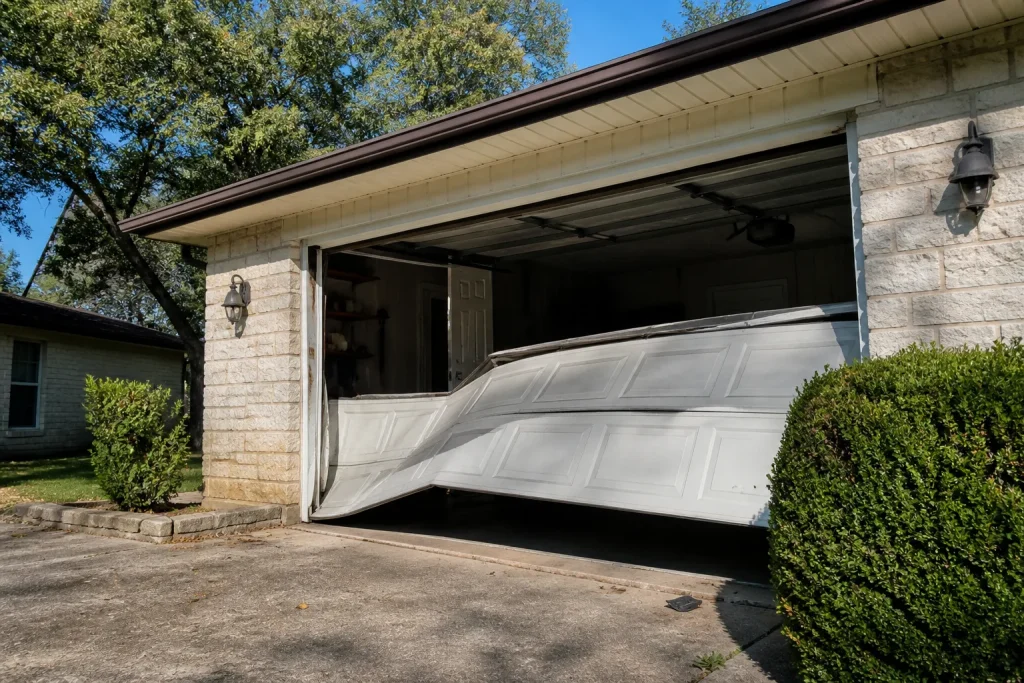
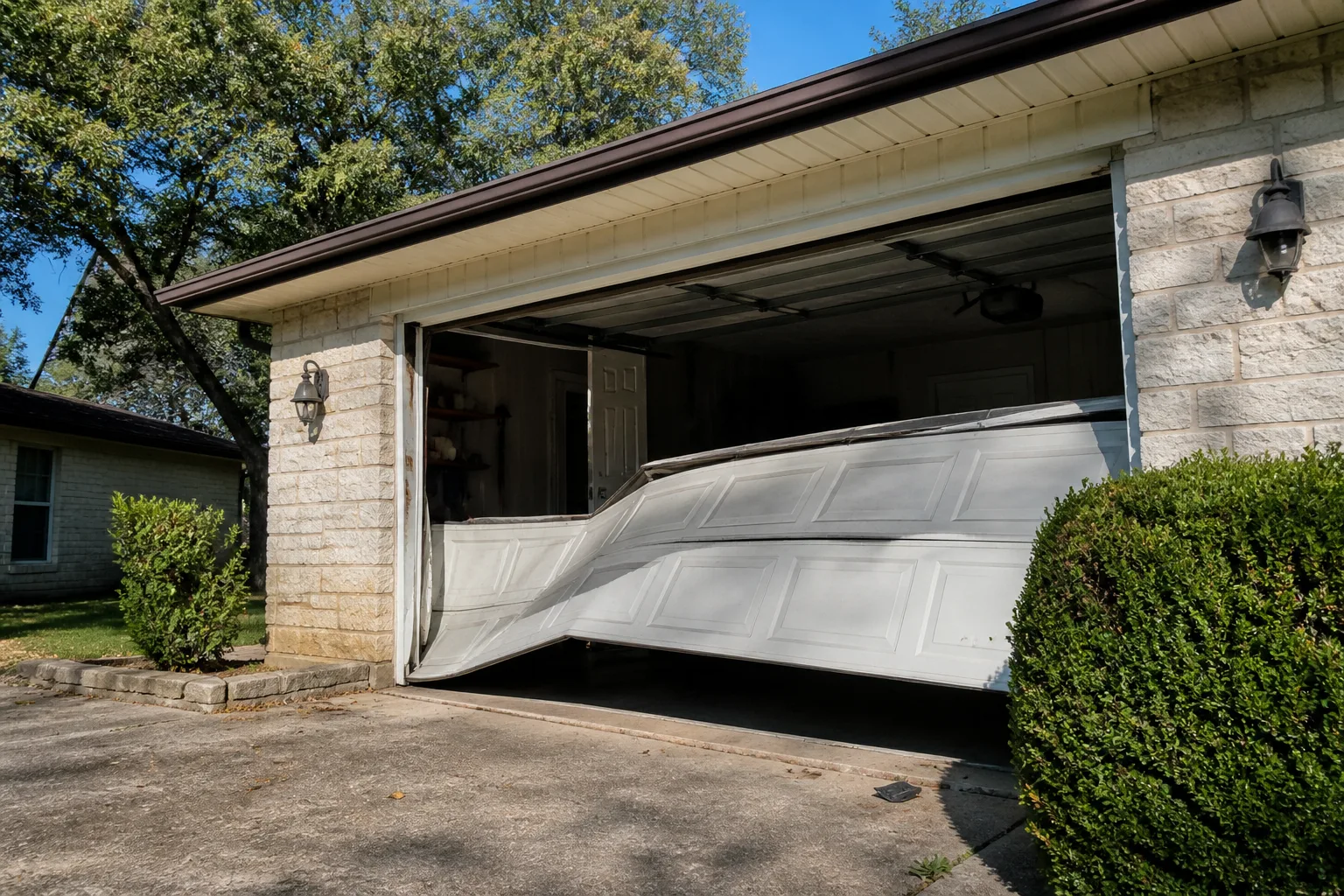
If the door is fully closed and won’t open, you’re in the safest possible failure. Leave it. If the door is fully open and won’t close, your priority shifts to securing the opening (more on that below). If the door is stuck halfway, hanging crooked, or making a grinding or snapping noise, do not touch it further. A door in that state is under load and can drop. That’s a stop-and-call situation.
One more thing: don’t start disconnecting springs, cables, or brackets to “see what’s going on.” The parts that fail most often are also the parts under the most tension, and they don’t announce themselves.
How do you use the emergency release cord without making things worse?
The red release cord on your opener is for disconnecting the door from the motor, not for fixing a broken door. Pull it only when the door is fully closed and at rest, and only when the problem is clearly the opener rather than the door itself. If you pull that cord while the door is halfway up or under uneven tension, the door can slam down or the trolley can jam in a way that’s harder to reset.
Once the cord is pulled, the door is in manual mode. It should lift and lower by hand with steady, even resistance. If it feels heavy, catches, or wants to drift back down on its own, the door’s balance is off, and that usually points to spring trouble. In our experience, homeowners who pull the cord on a crooked or spring-broken door just create a second problem on top of the first.
On LiftMaster and Chamberlain openers, the release and re-engagement sequence has its own feel, and forcing the trolley back into place can damage the carriage. If you’re not sure the door is safe to disconnect, leave the cord alone and call. We answer 24/7, and fast dispatch runs from 7am to 7pm, Sunday through Friday.
Is it a true emergency or an urgent repair you can schedule?
Not every failure needs a technician at the door in the next hour, and knowing the difference can save you stress and money. A true emergency is a door that’s stuck open and can’t be secured, a door hanging off its tracks, a cable that’s snapped and whipping, or a door that dropped and is blocking a vehicle you genuinely need. Those are the calls that matter most.
An urgent-but-schedulable problem looks like this:
- Garage door won’t open, door is closed and level: Safe. Call and book a repair.
- Opener runs but the door doesn’t move: Often a stripped gear, a dead capacitor, or a disconnected carriage. Urgent, not dangerous.
- Door reverses on its own or the safety sensors are tripping: Inconvenient and worth fixing soon, but the door itself is intact.
- Remote or keypad stopped working: Rarely a door problem at all. Often a battery, a pairing issue, or a logic board.
- Loud bang from the garage, door won’t lift, spring looks broken: A broken spring. Treat it as a same-day call, not a DIY job.
If you’re in Princeton Heights and you’re not sure which category you’re in, describe what you see and we’ll help you sort it. That’s what the phone is for.
How do you secure a garage door that’s stuck open until it can be repaired?
A door that won’t close leaves your home and everything in the garage exposed. The goal isn’t to force it shut. The goal is to make the opening difficult to enter until a technician can assess it. A few practical moves work for most Princeton Heights homes:
- Disconnect the opener so it can’t try to close on its own or fight a manual attempt.
- Block the opening from inside with something heavy and stable. A vehicle parked close to the door, a stack of storage bins, or a piece of furniture set against it works. Don’t lean anything on the door itself.
- Move valuables out of the garage if the door is going to be open for hours. Tools, bikes, and anything easy to carry are the first things to relocate.
- Lock the connecting door between the garage and the house, and check that any smart opener app shows the door as open so you’re not caught off guard.
- Turn on outdoor lighting near the driveway so the opening isn’t a dark spot after sunset.
For a modern LiftMaster or Chamberlain opener with app control, you can also set an alert so you know if the door moves. It’s not a lock, but it’s a useful layer while you wait.
What should you have ready when you call for emergency garage door repair?
The more accurately you can describe the failure, the faster the right parts show up. On a spring or opener job, the brand and model of the door and the opener determine which springs, cables, gears, or boards a technician brings. A vague “it’s broken” call often means a second trip. A specific one usually means a first-visit fix.
Have these ready before you dial:
- Door brand and rough age: Clopay, Amarr, Wayne Dalton, and Raynor are the names we work with most, and each has its own panel and hardware quirks.
- Opener brand and model: LiftMaster, Chamberlain, Genie, and Craftsman cover most homes. The model number is usually on a label under the light cover or on the back of the motor housing.
- What the door is doing right now: Fully open, fully closed, halfway, crooked, or hanging by a cable.
- What you heard when it failed: A bang, a snap, a grinding noise, or nothing at all. That single detail separates a spring break from an opener failure more often than not.
- Whether the door is secure: So the technician knows how urgently to prioritize the visit.
We work across all of those brands specifically, which is why we ask. Knowing a Raynor door from a Clopay door changes how we approach the spring and track hardware, and knowing the opener model tells us whether we’re looking at a legacy system or a connected one with a logic board.
When should you call a pro instead of troubleshooting?
Call a trained technician the moment the problem involves springs, cables, or a door that’s off its tracks. High-tension torsion and extension springs store an enormous amount of energy, and a spring that’s under load can release it with no warning. This is one of the most dangerous repairs in the trade, and it’s not a weekend project. A cable that’s snapped can whip. A door that’s come off its track can drop.
What you can safely do is the small stuff: check the opener’s circuit, replace remote batteries, wipe off the safety sensors, look for a tripped breaker. Beyond that, the risk climbs fast. We handle spring work as a core service precisely because it warrants an experienced hand, and our technicians have up to 11 years of experience with it.
If you need help beyond the immediate failure, we cover the full range. You can book garage door repair for a door that’s stuck, misaligned, or noisy, and garage door opener repair when the motor is the problem rather than the door. When a door is beyond saving, garage door installation is the next step. And for a quick overview of everything we handle, start at Garage Door Repair Princeton Heights.
One small comfort: a door that won’t cooperate at 6am still qualifies as a bad morning, not a disaster. We’ve heard every version of “I tried to fix it myself first.”
The Bottom Line
The ten minutes right after a garage door failure are about protecting the door, your car, and yourself. Stop operating it, cut the power, assess whether the door is level or hanging, and don’t force anything that’s off its tracks or under tension. Know whether you’re facing a true emergency or an urgent repair you can schedule. Secure an open door from the inside without leaning on it. And when you call, have the door and opener brands ready so the right parts come the first time.
If you’re in Princeton Heights and need help, Garage Door Repair Princeton Heights offers free estimates. Call (855) 799-9554. We answer 24/7, with fast dispatch from 7am to 7pm, Sunday through Friday. The written estimate sets the price, and it’s agreed before any work starts.
Frequently Asked Questions
No. A broken torsion or extension spring is under extreme tension and can cause serious injury if handled without the right tools and training. Leave it alone, keep the door closed if it’s safe to do so, and call a technician who works on springs as a core service. Call (855) 799-9554 for a free estimate. We answer 24/7.
Disconnect the opener, block the opening from inside with something heavy and stable, move valuables out of the garage, and lock the door between the garage and the house. Don’t try to force the door closed. If you need it handled, call (855) 799-9554. We answer 24/7 with dispatch from 7am to 7pm, Sunday through Friday.
Pricing depends on the failure. A spring replacement typically runs $180 to $340 for one spring, and a matched pair is usually replaced together at about twice that. Opener repairs are quoted per job. The written estimate is the price, and it’s agreed before any work begins. Call (855) 799-9554 for an exact quote. Estimates are free.
No. The written estimate sets the price and is agreed before any work starts. If the diagnosis reveals something the phone call didn’t, you’ll hear about it before anything is touched. Call (855) 799-9554 to get a free estimate booked.
The local professionals who perform the work are licensed and insured as their state requires. Our technicians have up to 11 years of experience, and we work across LiftMaster, Chamberlain, Genie, Clopay, Amarr, Wayne Dalton, Craftsman, and Raynor equipment. Call (855) 799-9554 for a free estimate.
Written by the team at Garage Door Repair Princeton Heights.
Need Garage Door Help?
Call Garage Door Repair Princeton Heights - the local pro we connect you with is licensed and insured, here with fast help in Princeton Heights.
(855) 799-9554